Sunday, December 19, 2010

Praying Mantis


Found this beauty enjoying the sun following two days of heavy rains. Its common knowledge that these insects can turn their heads 180 degrees.  What I did not know was that situated between its two large compound eyes are three tiny simple eyes.  The latter are used for light detection only.


Also spent some time photographing flowers in my parents' garden.  Unfortunately I had to use a high ISO setting as it was quite late in the afternoon.


Kissing Pollen Stems


It was the perfect end to a good day....  d:-D

Wednesday, December 8, 2010

My Intro To Underwater Photography - Phillip's Reef

Silvertip nudibranch (Janolus capensis)
Diving with Ocean Divers International has opened up a whole new world for me.  On my first dive with them the DM (dive master ) took us to a sand patch and indicated that we should sit  down for a moment.  I couldn't understand the reason for the 'request', but being the new kid on the block I did as I was told.  I still remember listening to the sound generated by my breathing aparatus and the bubbles flowing from it  - then all of a sudden I became aware of a whole range of other sounds created by the fish and the inhabitants of the reef.  I was in awe... how come I've never heard it before?  Maybe its because I got use to swimming from point A to point B and then returning to the back to the boat again...

A few months later I joined Juan Snyman on another dive at Phillip's Reef.   Not only  is he a qualified DM, but he's also a very keen underwater photographer.  Halfway through the dive he handed me his camera, and I immediately started to panic.  How does a person swim against the strong currents and still manage to take photos?  Well, I gave it a shot and I here some of my attempts:

Heart urchin (Spatagobrissus mirabilis)
Just for info - Phillip's Reef is situated in Algoa Bay and was named after Philip Coeztee, a marine biologist who did extensive research on this reef.  The maximum depth here is approximately 18 metres.
Choirboys (Podoclavella sp)
Frilled nudibranch (Leminda millecra)
What I enjoy most of underwater photography is returning home and sharing my diving experience throught my photographs with my husband and friends.

Monday, December 6, 2010

The Haerlem Wreck

Cryptic Sponge Crab (Crytodromiosis spongiosa)

Last Sunday I joined several divers from Ocean Divers International on a wreck dive.  Since I started diving in 2002, The Haerlem, an SA Navy frigate scuttled in late November 1987, has been one of my favourite dive sites in Algoa Bay.  I can't really say why - maybe it has something to do with the eary feeling I get when I look into the portholes. On the top of the deck the average depth is approximately 18 metres and 21 metres at the stern.

Square-mouthed Striped Anemone (Anthothoe sp)

The wreck is home to a large number of leopard and pajama catsharks, soft corals and a variety of other fish, e.g. batfish.

A Leopard Catshark playing hide and seek....
The viz was particularly bad on the day of the dive - one metre at the most.  I buddied with Juan Snyman, who is one of the best divemasters in Port Elizabeth.  What I love most about diving with him is that he takes time in showing fellow divers all the little interesting sea creatures. 

Basket Star (Astrocladus euryale)

My two favourite sea creatures, with the exception of dolphines and whales, are basket stars and nudibranchs.  The basket star is a type of brittle star and often attaches itself to sea fans (see pic above).

Crowned Nudibranch (Polycera capensis)
Most nudibranchs or sea slugs have flamboyant colour patterns - a warning to potential preditors that they are distasteful or even poisonous.

Variable dorid (Aphelodoris brunnea -1)

Staghorn False Coral (Gigantopora polymorpha)
Nippled Sea Fan (Eunicella papillosa)
Black Nudibranch (Tambja Capensis)
Scollaped Lacy False Coral (Reteporella lata)
Cobbled Starfish (Calliaster baccatus)

Saturday, December 4, 2010

3,2,1....BUNGEE!!!!!

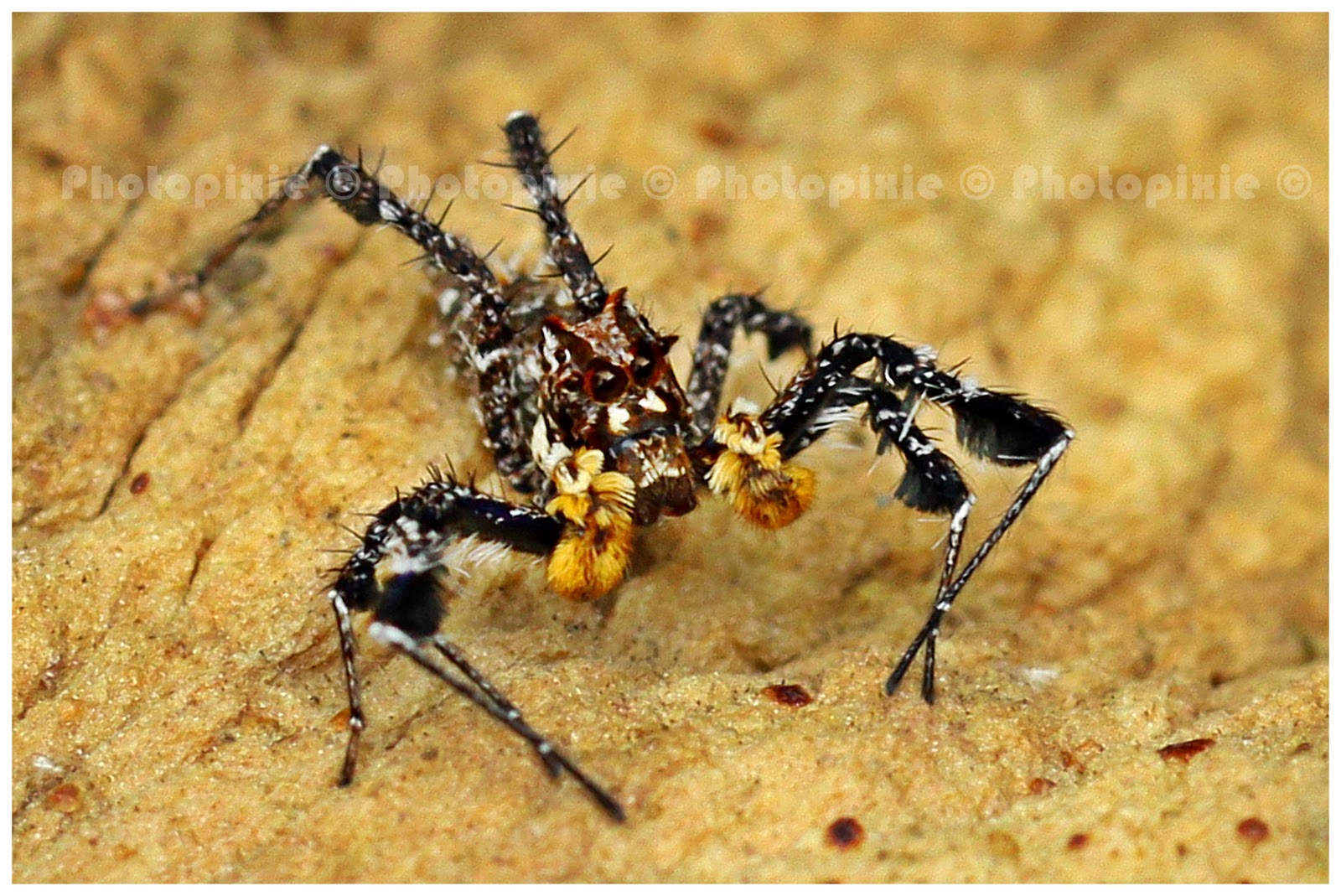
Jumping Spider (Portia sp.)
Upon returning from work on Thursday, I found this little spider on my dining room table 'waiting for supper to be served'.  It was less than 2cm in size and very fast on its feet. This little fellow belongs go the Saliticidae (jumping spiders) family,  which is the largest spider family in the world. Its favourite food source - primarily other spiders!  YUCK!!!!! 

After releasing it back into 'the wild', I grabbed my camera to take a few photos.  It kept running up and down the stem of one of our succulent plants.  Eventually it found solice under a dried leave.  Still trying to 'capture' the perfect photo, I turned the leave around - AND GUESS WHAT I SAW.....

David and Goliath
Don't be too brave little spider! Sometimes its best just to turn around and 'walk' away.... 


I've battled for days to identify the spider in the pictures above.  Finally I decided to contact Mr Lambert Smith to ask him for help.  Here is what he had to say:

"From what I can see this appears to be a Baboon Spider from the family Theraphosidae. It is able to deliver a painful bite but is not known to be toxic to humans."
For more info on insects and spiders found in South Africa, visit www.insecta.co.za

"If you wish to live and thrive, let the spider run alive" Proverb


Sunday, November 28, 2010

Green Mottled Planthopper


Classification
Class: Insecta
Order: Hemiptera
Family: Flatidae
Genus: Siphanta
Species: Hebes


Found this beautiful planthopper in our garden.  Planthoppers are sapsuckers that feed on leaves, branches and trunks of the host tree.

They are also called torpedo bugs, which refer to the great leaping ability of mature nymphs.

Sunday, October 31, 2010

The Weevil

Weevils are a familiar sight in our garden, especially amongst some of the succulent plants, which they love to feast on.  For years the only weevil known to me was the wheat or granary weevil - so, imagine my surprise when I discovered that there are more than 40 000 species of weevils. 

I spotted the weevil walking along the paving in our backyard.  It must have felt threatened at some stage as it feigned death for a few minutes before taking off  again.


Thursday, October 14, 2010

Biennial Indian-Brazil-South African Maritime Exercise


The South African coast was abuzz with activity as warships from the navies of India, Brazil and South Africa joined forces to participate in the biennial Indian-Brazil-South Africa Maritime (IBSAMAR) exercise.

The aim of the two-week nautical exercise, which took place from 10 to 26 September 2010, was to increase interoperability and enhance military and diplomatic understanding amongst the navies of the participating countries.

Due to our geographical location it was decided that South Africa will be the host country for these exercises.  India was the leady navy for this edition the IBSAMAR.

These pictures were taken from the Humerail Shopping Centre during their visit to  the Port Elizabeth Harbour.  This is my first attempt at the tilt-shift effect - although I still need lots of practice to master the technique, I'm very happy with the results.